Vintage Tarot Coloring Sheets Volume II — A Designer's Review
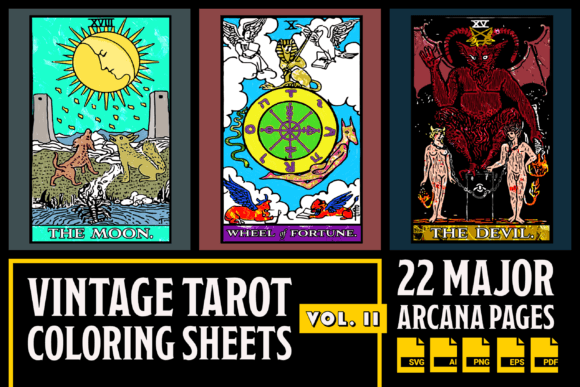
I opened the file folder for Vintage Tarot Coloring Sheets Volume II expecting standard tarot imagery, but what I got was something far more useful for embroidery work than I anticipated. The set includes all 22 major arcana cards, each one drawn with a deliberate vintage hand that feels less like a coloring book and more like a woodcut revival. The linework has weight. The figures have presence. And as someone who has spent years translating flat artwork into stitched goods, I could immediately see which cards would sing on fabric and which ones would need a little extra love before hooping up.
Before I go further, let me frame this around a real project I'm working on. A client asked me to create a small run of custom embroidered tote bags for a boutique that sells handmade metaphysical goods. The shop wanted something that felt old-world but not costume-like, something with enough detail to feel premium but not so dense that the tote bag fabric would pucker under heavy stitching. I pulled up Vintage Tarot Coloring Sheets Volume II and started mentally auditioning cards. The High Priestess caught my eye first. The line spacing, the symmetry, the way the negative space sits inside the composition — it practically begged to become an embroidery design.
First Impressions and Visual Mood
The mood across all 22 sheets is consistent. This is not the shiny, digital tarot art you see on mass-produced decks. The linework has a slight irregularity that mimics hand-drawn ink, and the compositions lean into antique woodcut aesthetics. For an embroidery designer, that matters because vintage-style line art translates beautifully into satin stitch and running stitch. The visual personality of Vintage Tarot Coloring Sheets Volume II feels grounded, slightly mysterious, and mature — exactly the kind of thing that catches a buyer's eye on a craft fair table or in an Etsy listing thumbnail.
The full-bleed 8.5 x 11 inch dimensions give you room to work. When I pulled the SVG file into my digitizing software, I had enough canvas to scale the design up for a tote bag center panel or down for an embroidered patch without losing the essential character of the artwork. The PNG files are clean enough to use as printable mockups, which is a nice bonus if you sell digital embroidery files and need realistic preview images for your shop listings.
How the Design Translates to Embroidery Projects
Let me be honest about something. Not every coloring sheet makes a good embroidery design. Some have too much detail in too small a space. Others rely on shading that disappears when you reduce the image to stitch paths. Vintage Tarot Coloring Sheets Volume II surprised me because many of the cards are built on bold outlines and clear internal shapes — exactly what you want when you are planning fill stitch areas and satin stitch borders. The Fool card, with its open composition and distinct figure, would make a striking embroidered patch. The Sun card, with its radiating lines, could become a gorgeous applique design on a baby blanket or a nursery pillow cover.
I tested a few designs on scrap cotton fabric before committing to the final tote bag project. The Star card, which I digitized as a single-color line art embroidery, stitched out cleanly with a simple running stitch. The thread sat nicely on the fabric surface without pulling, and the details remained legible at about 5 inches tall. That is not always the case with intricate artwork, so I took it as a good sign. For a sweatshirt embroidery project, I would probably choose one of the bolder cards like Death or The Tower, where the strong silhouettes hold up even when stitched on textured fabric texture like fleece or French terry.
Real-Life Embroidery Applications
Let me map out where I think Vintage Tarot Coloring Sheets Volume II shines brightest for embroidery work.
For custom apparel, the designs work well on t-shirts, sweatshirts, and jackets. The vintage line quality gives a garment an instant heritage feel. I can see The Magician or The Hermit on the back of a denim jacket, stitched in a single deep gold thread, and the result would look like something from a high-end boutique rather than a craft project. For tote bag design, the larger cards like The World or The Wheel of Fortune fill the panel space beautifully. For kitchen towel or tea towel accents, the simpler cards work better. The Lovers, with its delicate linework, might lose clarity on a textured towel, but The Chariot or Strength would hold up fine.
For personalized gift projects, the birth card concept is powerful. A customer who knows their associated tarot card based on their birth date will feel a deep connection to a handkerchief, pillow cover, or zipper pouch embroidered with that specific card. That kind of emotional resonance is what turns a handmade product into a repeat purchase driver. I have already added a note in my client proposal about offering birth card customizations on the tote bags, and the shop owner loved the idea.
The embroidered patch potential is also strong. Cards like The Moon, with its clear central imagery, reduce well to patch size. A 3-inch patch of The Moon stitched onto a cap or a backpack flap would look intentional and artistic. The commercial embroidery applications extend to aprons, aprons for tarot readers or metaphysical shop owners, and even small zipper pouches sold as part of a curated gift set.
Where to Use Caution
I always tell fellow embroidery designers to respect the limits of their medium. Vintage Tarot Coloring Sheets Volume II contains detailed cards that will challenge small hoop sizes. The High Priestess, for example, has fine internal lines around the veil and the scroll. If you try to stitch that at 2 inches wide, those details will close up and become muddled. I recommend keeping the stitch area at least 4 inches for the more detailed cards, and closer to 6 or 7 inches for cards like The Hanged Man or Judgment, where the symbolic elements are tightly packed.
Be careful with dark fabric backgrounds. The vintage line art relies on contrast, and a black sweatshirt will swallow dark thread colors whole. If you are stitching on dark garments, consider using a light or metallic thread to maintain visibility. On stretchy fabric like performance tees or baby onesies, use a proper cutaway stabilizer to prevent distortion. The detailed linework will shift if the fabric moves during stitching, and a crooked tarot card looks unprofessional — there is no hiding that.
For curved surfaces like caps, stick to the simpler cards. The Fool, The Sun, The Star, and The World all have centralized compositions that adapt well to the curve of a cap crown. Cards with heavy border details or square framing, like The Emperor or The Hierophant, will look warped on a curved surface unless you significantly adjust the digitizing.
Practical Embroidery Designer Notes
Before you commit Vintage Tarot Coloring Sheets Volume II to a finished product, do your homework. Here is what I recommend based on my own testing.
First, test the design on scrap fabric from the same batch you plan to use for the final product. Cotton behaves differently than linen, and both behave differently than a poly-cotton blend. The line art from these sheets looks best on smooth, medium-weight fabrics that hold a crisp stitch edge. Second, check thread color contrast carefully. I stitched a test of The Hermit in dark gray on a natural linen background, and the lantern detail nearly disappeared. A slightly lighter thread or a subtle sheen can make all the difference.
Third, review stitch density before running the final file. The SVG and AI files from Vintage Tarot Coloring Sheets Volume II give you clean vector paths, but you still need to set your own stitch parameters. Overly dense fill stitches on a card like The Lovers will create a stiff, boardy patch that feels unpleasant against the skin. Fourth, confirm hoop size for each card you plan to use. The original files are 8.5 x 11 inches, but your embroidery hoop may be 4x4, 5x7, or 6x10. Scale the design down in your digitizing software and check for detail loss before you stitch.
Fifth, inspect small details at actual stitch size. The lettering that appears on some cards in the set will likely be too small to embroider cleanly unless you are working at a large scale. I usually remove or simplify tiny text elements when adapting artwork for machine embroidery design purposes. Sixth, test in black and white mockups to see how the design reads without color. A strong embroidery design should hold up in silhouette. Many of the cards in this set pass that test, but a few of the more detailed ones benefit from simplification.
Seventh, compare light and dark fabric backgrounds before committing to thread colors. The same design stitched in white on a charcoal sweatshirt will read completely differently than black thread on a cream tote bag. Eighth, use proper stabilizer for your fabric type. Cutaway stabilizer for knits, tear-away for wovens, and a water-soluble topper for textured fabrics like towels or fleece. The vintage linework deserves a clean, crisp stitch, and that starts with good stabilization.
Commercial Use and Licensing Considerations
This is where many designers get nervous, and I want to address it directly. Vintage Tarot Coloring Sheets Volume II comes from the Coloring Pages Amp category, specifically listed under Graphics. The product description mentions KDP readiness, which tells me the files are intended for print and digital product creation. But what about embroidery? If you plan to stitch these designs onto products you sell, whether on Etsy, at craft fairs, or through your own website, you need to confirm the licensing terms. The file types provided — SVG, PNG, EPS, AI — are all formats that work well for digitizing embroidery designs, but format compatibility does not equal commercial embroidery permission.
I always advise fellow Etsy seller friends and craft business owners to read the license carefully. Some graphics products allow physical product creation. Others restrict use to printed items only. If the license does not explicitly cover embroidery or sewn goods, reach out to the seller and ask. A quick message can save you from a copyright issue down the road. The same applies if you plan to sell digital embroidery file versions of these designs. Derivative digital products usually require an extended license, and you should never assume that a standard license covers that use.
How the Design Affects the Finished Product
When a customer picks up a tote bag with The Star embroidered on the front, they are not just seeing thread on fabric. They are registering an entire experience. The vintage quality of Vintage Tarot Coloring Sheets Volume II elevates a simple handmade product into something that feels curated and intentional. The mood comes through even in single-color thread. That is rare. Many designs lose their personality when you strip away color, but the linework here carries enough character to stand on its own.
For personalized gift projects, the tarot theme adds a layer of meaning that generic floral or geometric designs simply cannot match. A customer buying a birth card pillow cover for a friend is buying more than a pillow. They are buying a symbol of identity and connection. That emotional weight translates to higher perceived value, more customer trust, and stronger brand consistency if you build a product line around these designs.
For small shop product photography, the PNG files from the set double as printable mockup assets. I have used similar files to create digital previews for my Etsy listings, and the clean line art photographs well even in flat lay mockups. Buyers respond to clarity. A crisp preview image builds buyer engagement and reduces the hesitation that comes with custom or made-to-order items.
Final Thoughts Before You Stitch
I have worked with hundreds of design assets over the years, and Vintage Tarot Coloring Sheets Volume II stands out as a thoughtfully composed set that offers real versatility for embroidery projects. The collection is cohesive, the artwork is distinctive, and the file formats give you the flexibility to adapt the designs for machine embroidery design work, applique design layouts, or printable mockup creation. The 22 cards cover a wide range of visual moods, so you can build an entire product line around the set without it feeling repetitive.
My practical advice is this. Start with one card. Digitize it. Test it on your chosen fabric. Refine the stitch settings. Then expand to a small collection of three or four cards that share a similar visual weight. The consistency will make your product line feel cohesive, and the tarot theme will attract buyers who are looking for something with depth and personality. Whether you are making embroidered patch sets, custom apparel, holiday embroidery gifts, or boutique branding items, Vintage Tarot Coloring Sheets Volume II gives you a strong foundation to build on. Just stitch a test first, respect the detail level, and always check your license before you sell.